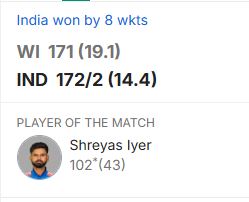
India vs West Indies 1st T20I 2026: India beat West Indies by 8 wickets in Lucknow as Shreyas Iyer smashed an unbeaten 102.
India vs West Indies 1st T20I 2026: India Win by 8 Wickets
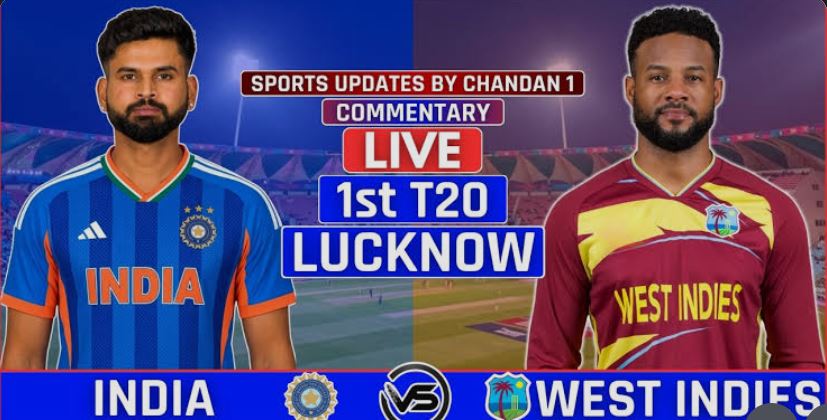
The India vs West Indies 1st T20I 2026 delivered exactly the kind of explosive cricket fans expect from a high-profile T20 international, with India producing a dominant eight-wicket victory over West Indies at the Bharat Ratna Shri Atal Bihari Vajpayee Ekana Cricket Stadium, Lucknow.
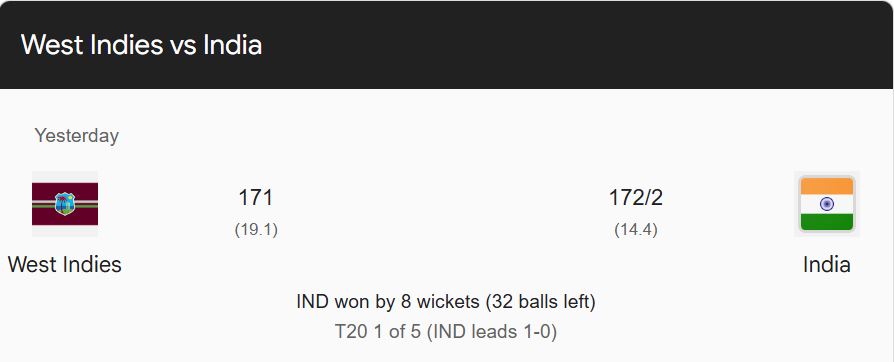
The match was played on Tuesday, October 6, 2026, with the scheduled local start time of 7:00 PM. India won the toss, chose to field, India vs West Indies 1st T20, restricted West Indies to 171 in 19.1 overs, and then raced to 172/2 in only 14.4 overs. The official BCCI match centre confirms India’s eight-wicket victory, while Cricket West Indies also records the same result with 32 balls remaining.
The biggest headline from the contest was undoubtedly Shreyas Iyer’s unbeaten 102, a breathtaking innings that transformed a potentially competitive chase into a one-sided finish. India vs West Indies 1st T20, India lost Abhishek Sharma and Sanju Samson early, but Iyer responded with fearless strokeplay and found a superb partner in Ishan Kishan.
Their unbeaten 137-run partnership completely changed the mood of the game. Reuters reported that Iyer reached his century from 43 deliveries and finished with 10 fours and six sixes, while India crossed the target with 32 balls still unused.
India vs West Indies 1st T20I Match Result
The final result was India won by 8 wickets. West Indies batted first after India captain Shreyas Iyer won the toss and elected to field, eventually scoring 171 all out in 19.1 overs. India vs West Indies 1st T20, India then chased the target of 172 in 14.4 overs, finishing on 172/2. The result gave India a 1-0 lead in the five-match T20I series, an important early advantage in a series that will move quickly from one venue to another.
For West Indies, the score of 171 looked respectable for a period, particularly after Shai Hope and Sherfane Rutherford rebuilt the innings following a difficult powerplay. However, India’s bowlers kept taking wickets at important moments, preventing the visitors from producing the kind of late-innings acceleration that can turn 160-170 into 190 or more.
India, by contrast, attacked the chase with remarkable confidence. India vs West Indies 1st T20, Even after losing two early wickets, the required run rate never became a major problem because Iyer’s aggressive batting kept the scoreboard moving at a rapid pace.
The eight-wicket margin also tells an important story. India did not merely reach the target; they reached it with considerable time to spare. According to the BCCI’s official match centre, India made 172/2 in 14.4 overs against West Indies’ 171 all out in 19.1 overs. India vs West Indies 1st T20, That means the Indian batting unit had enough control to finish the contest more than five overs before the scheduled end of the innings.
India vs West Indies 1st T20I Match Summary
West Indies’ innings began with immediate pressure as India’s attack found breakthroughs during the powerplay. Kamil Pooran was dismissed for 12 by Arshdeep Singh, while Shimron Hetmyer and Rovman Powell also departed cheaply. India vs West Indies 1st T20, At one stage, West Indies were in a difficult position at 44/3, creating the perfect opportunity for India to dominate the remainder of the innings. Instead, Shai Hope and Sherfane Rutherford showed composure and built a valuable partnership that briefly gave the visitors renewed momentum.
Hope contributed 52 while Rutherford made 56, and their partnership helped West Indies move away from serious danger. But India’s middle-overs bowling eventually regained control. Naman Dhir struck important blows, while Kuldeep Yadav, India vs West Indies 1st T20, Mayank Yadav and Axar Patel also played significant roles in breaking the West Indies batting order. West Indies were ultimately dismissed for 171 on the first ball of the 20th over.
India’s reply started less smoothly than the final result might suggest. Abhishek Sharma scored 21 from 10 balls before being dismissed, while Sanju Samson fell for 11. India were 35/2, and suddenly West Indies had a genuine opportunity to put pressure on the chase.
That opportunity disappeared quickly, however, because Iyer and Kishan combined to produce one of the most decisive partnerships of the match. Their unbeaten stand took India from 35/2 to victory and demonstrated the difference between a competitive total and a winning total on this occasion.
IND vs WI 1st T20I Full Scorecard
The match scorecard paints a clear picture of how dramatically the game changed between innings. West Indies posted 171 all out in 19.1 overs, India vs West Indies 1st T20, while India reached 172/2 in 14.4 overs. The BCCI and Cricket West Indies both confirm the eight-wicket result, with West Indies Cricket specifically recording that India won with 32 balls remaining.
Team Score Overs Result
West Indies 171 all out 19.1 Lost
India 172/2 14.4 Won by 8 wickets
The individual batting figures underline the contrast. For West Indies, Shai Hope scored 52 and Sherfane Rutherford made 56, providing the bulk of the resistance. For India, Shreyas Iyer remained unbeaten on 102, while Ishan Kishan finished unbeaten on 37. India vs West Indies 1st T20, The combination of Iyer’s extraordinary strike rate and Kishan’s controlled support meant West Indies were never able to build sustained pressure during the second innings.
West Indies First Innings
West Indies were bowled out for 171 in 19.1 overs. The innings contained two important individual contributions, but the visitors struggled to maintain partnerships around them. India vs West Indies 1st T20, Hope’s 52 came from 37 deliveries, while Rutherford’s 56 came from 34 balls, giving West Indies a much-needed scoring burst in the middle and latter stages of the innings.
The problem was the lack of support. Once India separated the main partnership, the West Indies innings lost momentum rapidly. Roston Chase made only five, Romario Shepherd contributed seven, and the lower order could not provide the final surge needed to push the score beyond the 180-mark. The Indian bowling attack therefore succeeded in turning a promising recovery into a total that proved far too modest against India’s aggressive batting response.
India Successful Run Chase
India’s chase was a lesson in controlled aggression. Abhishek Sharma started quickly with 21 from 10 deliveries but was dismissed in the third over. India vs West Indies 1st T20, Sanju Samson followed for 11, leaving India at 35/2 and giving West Indies a brief opening. Instead of allowing the required rate to rise, Iyer immediately imposed himself on the bowling attack.
Ishan Kishan played the ideal supporting role, remaining unbeaten on 37 as Iyer attacked from the other end. Their partnership of 137 runs from 67 deliveries completely removed the pressure from India’s chase. By the time India reached 172/2 in the 15th over, West Indies had run out of answers.
Shreyas Iyer Produces a Stunning Captain’s Knock
If one performance deserves to define the India vs West Indies 1st T20I, it is Shreyas Iyer’s sensational century. The Indian captain finished unbeaten on 102 from 43 balls, hitting 10 fours and six sixes. Reuters reported that it was his maiden T20I century, India vs West Indies 1st T20, while the Indian Express described it as a commanding captain’s innings that powered India to an eight-wicket victory.
What made the innings especially impressive was the situation in which Iyer entered. India had already lost two wickets, and West Indies could reasonably have expected the pressure to build. India vs West Indies 1st T20, Instead, Iyer treated the chase as an opportunity rather than a problem. He combined powerful hitting with smart placement, finding boundaries when the field allowed them and rotating the strike when the bowlers tried to defend the ropes.
His century also changed the entire narrative of the match. West Indies had reached 171 after fighting back from early setbacks, but Iyer’s assault made that total look surprisingly small. India vs West Indies 1st T20, A captain’s role in T20 cricket is not simply to score runs; it is also to understand the rhythm of a chase. Iyer did exactly that, shifting from controlled batting to explosive acceleration at precisely the right time.
Ishan Kishan Provides Calm Support
While Iyer naturally took the headlines, Ishan Kishan’s unbeaten 37 was an important part of India’s successful chase. His contribution gave Iyer the freedom to attack without worrying about constantly facing every delivery. India vs West Indies 1st T20, Instead of trying to compete with Iyer’s scoring rate, Kishan played the complementary role that successful T20 partnerships often require.
Their unbeaten partnership was the bridge between India’s early uncertainty and its emphatic finish. When Abhishek Sharma and Sanju Samson were dismissed, India needed stability as much as aggression. Kishan provided that stability, while Iyer supplied the fireworks. The combination worked perfectly.
The 137-run partnership was particularly damaging for West Indies because it removed any chance of a late comeback. Every over that passed without a wicket increased India’s control, and every boundary made the required target look smaller. By the final phase, India vs West Indies 1st T20, the match had effectively become a showcase for Iyer’s batting rather than a contest between two evenly matched sides.
West Indies Batting Struggles Under Pressure
West Indies showed enough batting quality to suggest that 171 could have been competitive, but their innings lacked consistency. The early collapse put them under pressure, and although Hope and Rutherford rebuilt the innings, the visitors could not finish strongly enough. India vs West Indies 1st T20, A T20 innings often depends on converting a middle-over partnership into a powerful final five overs, and that transition never fully arrived for West Indies.
India’s bowling plans also deserve credit. Arshdeep Singh struck early, while the spin and pace options were used effectively through the middle overs. India vs West Indies 1st T20, Naman Dhir’s three wickets were particularly valuable, and Kuldeep Yadav and Axar Patel also contributed with two wickets each. The bowling unit repeatedly forced West Indies to rebuild instead of allowing them to maintain a continuous attacking rhythm.
The final total of 171 was therefore a combination of West Indies’ useful individual batting performances and India’s disciplined wicket-taking. Had West Indies kept more wickets in hand for the final overs, the equation could have been different. Instead, India vs West Indies 1st T20, they entered the closing stages with too many wickets already lost, limiting their ability to attack without taking excessive risks.
Shai Hope Leads the Recovery
Shai Hope played a crucial role in preventing West Indies from collapsing completely. After the early wickets, his 52 from 37 deliveries provided the stability the visitors desperately needed. India vs West Indies 1st T20, Hope’s innings combined patience with boundary-hitting, helping West Indies recover from their poor powerplay position.
His dismissal, however, became one of the key moments of the innings. Naman Dhir removed Hope after the partnership had given West Indies a platform, India vs West Indies 1st T20, and India’s bowlers immediately applied more pressure. Hope’s wicket meant West Indies lost one of the players capable of controlling the innings through the middle overs.
Sherfane Rutherford Adds Crucial Runs
Sherfane Rutherford was another major contributor, scoring 56 from 34 balls with six fours and three sixes according to the available scorecard. India vs West Indies 1st T20, His strike rate of more than 160 gave West Indies the acceleration they needed during the middle and later stages.
Rutherford’s innings demonstrated why West Indies remained competitive despite their poor start. His ability to find boundaries helped keep the scoreboard moving, but his dismissal also came at an important time. Mayank Yadav removed him, India vs West Indies 1st T20, and West Indies could not reproduce the same level of attacking momentum after his departure.
India’s Bowlers Set Up the Victory
Although Iyer’s century became the headline, India’s victory was established by the bowlers first. Restricting a dangerous West Indies batting lineup to 171 was a major part of the equation. The Indian attack took wickets throughout the innings rather than allowing West Indies to reach a huge total and put the chase under pressure.
Naman Dhir took three wickets, while Kuldeep Yadav and Axar Patel claimed two each. Arshdeep Singh and Mayank Yadav also picked up wickets. India vs West Indies 1st T20, This distribution is important because it shows India were not dependent on a single bowler. Different styles were able to create problems at different stages of the innings.
Arshdeep’s early breakthrough helped India establish control, while the middle-overs bowlers prevented West Indies from turning their recovery into a huge score. The result was a target that India’s powerful batting lineup could attack aggressively.
Naman Dhir Makes a Major Impact
One of the most encouraging elements for India was the impact of Naman Dhir. The debutant returned figures of 3/31 from four overs, making an immediate contribution in a high-profile international match. His wickets included the important dismissal of Shai Hope and another breakthrough against Romario Shepherd.
For a debutant, stepping into a T20I environment can be intimidating. The pressure is even greater when facing a West Indies lineup capable of explosive hitting. Dhir’s performance showed composure and an ability to execute his plans when the situation demanded it.
His performance also gives India’s team management another option as the five-match series progresses. A player who can contribute with the ball while fitting into India’s wider T20 combination can become particularly valuable during a long series. One strong performance does not define a career, but Dhir could hardly have asked for a better beginning.
The Turning Point of the Match
The decisive turning point came during India’s chase. West Indies had a genuine chance after removing both Indian openers, but they could not capitalize on the position. With India at 35/2, the visitors needed another quick wicket to make the chase uncomfortable. Instead, Iyer and Kishan produced an unbeaten partnership that completely flipped the contest.
Iyer’s acceleration was especially destructive because it prevented West Indies from settling into defensive bowling plans. Once the boundaries started arriving regularly, the target of 172 became less of a mountain and more of a countdown. The Indian captain effectively turned the final 137 runs of the chase into a demonstration of controlled T20 batting.
This is where the difference between a competitive total and a defendable total becomes obvious. West Indies had enough runs to create a contest, but India’s batting response was simply too strong. The match was not lost by one delivery alone; rather, India’s bowlers created a manageable target and Iyer ensured it was chased at extraordinary speed.
Bharat Ratna Shri Atal Bihari Vajpayee Ekana Cricket Stadium
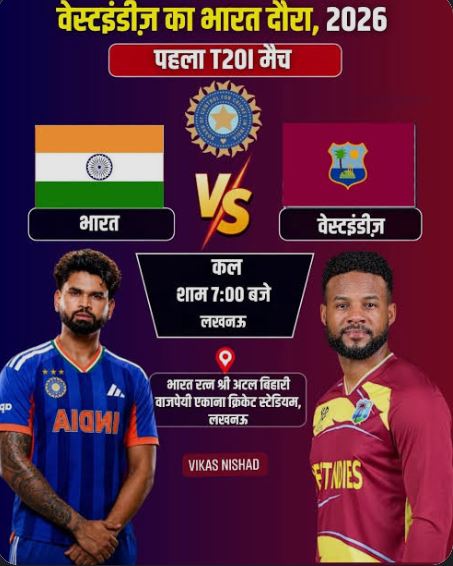
The match was played at the Bharat Ratna Shri Atal Bihari Vajpayee Ekana Cricket Stadium in Lucknow, one of India’s prominent modern cricket venues. The BCCI lists the ground as the venue for the opening T20I of the West Indies tour of India, while the official competition information confirms the match began at 7:00 PM local time.
The Lucknow setting added another layer of interest to the opening match. Before the game, reports also highlighted flooding concerns around parts of the city and near the stadium, although the stadium itself remained suitable for the match to proceed as scheduled. The contest ultimately went ahead and produced a complete result rather than a weather-affected finish.
For readers following crickickbuzz.online, the venue is an important keyword because searches around IND vs WI frequently combine team names with location, scorecard and match-result terms. Searchers are often looking for phrases such as IND vs WI Lucknow, Ekana Stadium T20I, and India West Indies Lucknow scorecard, making venue information useful for both readers and search visibility.
Toss and Match Strategy
The toss played an important role in shaping the contest. India won the toss and elected to field, allowing the hosts to understand the pitch and conditions before beginning their chase. That decision worked extremely well because India’s bowlers limited West Indies to 171 and the batting unit then attacked the target with confidence.
For West Indies, the key tactical challenge was to score heavily enough during the final stages of their innings. Hope and Rutherford did the hard work of rebuilding the innings, but the team needed more runs after their partnership ended. Losing wickets at regular intervals prevented them from reaching the kind of total that could have tested India’s middle order.
India, meanwhile, followed a straightforward T20 formula: take wickets, restrict the opposition, then attack the chase. Even after losing two wickets early, there was no need for panic because the required rate remained manageable. Iyer’s counterattack turned that tactical advantage into an emphatic victory.
What the Result Means for the T20I Series
The victory gives India a 1-0 lead in the five-match T20I series. The schedule published by Cricket West Indies lists the second T20I for October 9 at the JSCA International Stadium Complex in Ranchi, followed by matches in Indore, Hyderabad and Bengaluru.
For India, the opening win provides confidence and allows the team to carry momentum into the next game. The combination of disciplined bowling, a debutant making an immediate impact and a spectacular century from the captain gives the side plenty of positives. At the same time, India will know that losing two early wickets in a chase is an area that could become more dangerous against stronger bowling attacks.
West Indies face a more urgent challenge. Their batting showed flashes of quality, but the top order needs to contribute more consistently. The bowling unit also needs a strategy for dealing with India’s aggressive middle order, especially after Iyer demonstrated how quickly the game can disappear when a batter gets settled.
What to Expect in the Second T20I
The second T20I is scheduled for Friday, October 9, 2026, in Ranchi, according to Cricket West Indies’ official fixtures. The result in Lucknow means West Indies enter the next game needing a response, while India will be looking to extend their series advantage.
Selection will be one of the interesting talking points. India have several talented batting options, and the first match included the contrasting stories of early dismissals and a spectacular captain’s century. West Indies, meanwhile, will need to decide whether their batting order can produce a stronger powerplay and whether their bowlers can create more pressure after the early wickets.
The biggest question is simple: Can West Indies stop another Indian batting assault? If India continue to bat with the same freedom shown in Lucknow, the visitors will need either a significantly higher first-innings score or a much more disciplined bowling performance. A five-match series provides time to recover, but the longer India remain ahead, the harder the challenge becomes.
Conclusion
The India vs West Indies 1st T20I 2026 was a powerful opening statement from the hosts. West Indies managed 171 after useful half-centuries from Shai Hope and Sherfane Rutherford, but India’s bowling attack kept the total within reach. Naman Dhir’s three wickets, along with two each from Kuldeep Yadav and Axar Patel, helped India control the first innings and create the platform for the chase.
The second innings belonged to Shreyas Iyer. His unbeaten 102 from 43 balls, supported by Ishan Kishan’s 37 not out, powered India to 172/2 in just 14.4 overs. The unbeaten 137-run partnership destroyed West Indies’ hopes of defending their total and gave India an eight-wicket victory with 32 balls remaining.
For crickickbuzz.online, this match provides plenty of major search topics: India vs West Indies 1st T20I 2026, IND vs WI scorecard, Shreyas Iyer century, India vs West Indies result, West Indies tour of India 2026, Ekana Stadium and IND vs WI highlights. India now lead the five-match series 1-0, while West Indies will need a stronger all-round performance in Ranchi. If the first game is any indication, this T20I series has the potential to produce plenty of explosive cricket, tactical battles and individual performances worth following.
Frequently Asked Questions
- Who won India vs West Indies 1st T20I 2026?
India won the first T20I by 8 wickets. West Indies scored 171 all out, while India reached 172/2 in 14.4 overs. - Who scored a century in India vs West Indies 1st T20I?
Indian captain Shreyas Iyer scored an unbeaten 102 runs from 43 balls, including 10 fours and six sixes. - What was West Indies’ score in the first T20I?
West Indies were dismissed for 171 in 19.1 overs. Shai Hope scored 52 and Sherfane Rutherford made 56. - Where was India vs West Indies 1st T20I 2026 played?
The match was played at the Bharat Ratna Shri Atal Bihari Vajpayee Ekana Cricket Stadium in Lucknow on October 6, 2026. - When is the second India vs West Indies T20I?
The second T20I is scheduled for October 9, 2026, at the JSCA International Stadium Complex in Ranchi.
India vs West Indies 1st T20I 2026, IND vs WI 1st T20I, India vs West Indies, West Indies tour of India 2026, IND vs WI live score, India vs West Indies scorecard, Shreyas Iyer 102, India T20I 2026, West Indies T20I 2026, Ekana Stadium Lucknow, India cricket, West Indies cricket, IND vs WI highlights, India vs West Indies result, crickickbuzz.online